

A certain kind of buyer has always had help buying things.

A personal assistant could remember the household’s preferred toilet paper brand and make sure to keep it in stock. A travel agent could compare flights and hotels knowing a preference for nonstops. A personal shopper could turn a vague instruction into a thoughtful gift for a wedding you’re going to this weekend.
The customer had the need, but someone else did the thinking, comparing, and execution.
Now that we seemingly need fancy names for everything, that act is called “agentic buying”.
Agentic commerce is the software version of that behavior. A customer uses AI to help with parts of buying: researching options, comparing tradeoffs, filtering products, and eventually completing the purchase. The customer is still the end customer. The AI tool is help
Disruptive innovation often takes something rich people had and makes a cheaper version available to everyone.
Agentic commerce fits that pattern. A personal shopper used to be a luxury for the extremely rich.
Now, normal people may use one.
That doesn’t mean the software will be good at every purchase (or at all), or that customers will delegate every decision, or that brands should rebuild their entire marketing strategy around “being AI-centric”.

They shouldn’t only cater to ChatGPT
But it does mean that behavior that used to require human help may become normal in lower-stakes, everyday decisions.
That is enough to matter.
Who wants to spend mental effort on laundry?
Imagine someone needs laundry detergent.
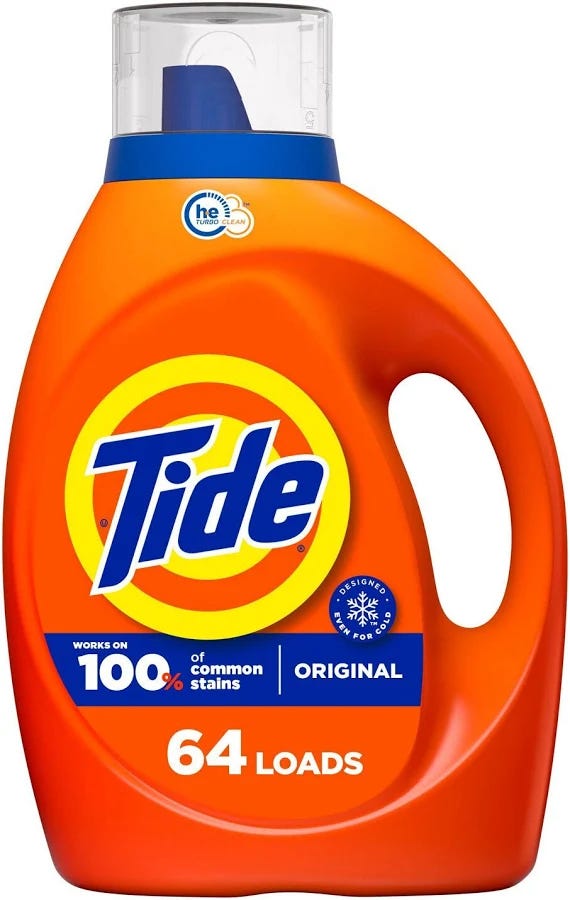
This is not a decision most people want to think about. They want clean clothes, a reasonable price, and to be done with the task.
A customer might ask ChatGPT’s Atlas or Claude: “Find me a good laundry detergent for a high-efficiency washer. I want something fragrance-free, good for sensitive skin, reasonably priced, and available this week.”

A person standing in a store aisle may notice the brand they grew up with, the sale tag, the bottle color2, the shelf placement, or the phrase “free and clear.”
A buying assistant may compare the product through a different set of signals: cost per load, HE compatibility, delivery availability, review language, ingredient clarity, and whether the product has been bought before.
The AI is not the buyer. It does not need clean clothes, and it does not care whether your kid gets a rash from the wrong detergent. But it may decide which options you see first
How Marketers Can Steal Programming Concepts to Market Better

How should you think of your product to best serve humans and robots?
.
For marketers, that changes the first interaction. The first evaluator of the product may not be a person looking at packaging, ads, or a homepage. It may be software trying to understand whether the product fits the customer’s instruction.
This is a buying behavior problem, not an AI problem
The wrong question is, “How do we market to robots?”
The better question is: if customers delegate parts of buying to software, what behavior are we trying to influence, and where does that behavior now happen?
That question matters because marketing should stay anchored to customer behavior. Remember The Golden Rule: Marketing should create the biggest behavior change for the least investment. That rule still applies. Agentic commerce only matters if it changes how people buy.
OpenAI has shopping research in ChatGPT and has published an Agentic Commerce Protocol for connecting merchant data to AI-mediated purchases. Claude is not primarily a shopping product, but Clawdbot has been set up to buy things for people. (Please dont put your credit card in an unmanaged AI tool)
Not that every purchase will move inside an AI assistant.
However, more buying journeys may include a software intermediary before the human sees the final options.
Business fundamentals do not change because of that. But tactics should.
Marketing’s Four Ps Aren’t Changing
The 4 Ps of marketing (Product, Place, Promotion, Price) are fundamental and solid.
Agentic commerce does not repeal any of that. It changes how those fundamentals may be evaluated.
A robot personal shopper changes what gets noticed. It does not change what matters.
Product: the offer still has to be good, but now it has to be legible
No buying process makes bad detergent good.
The product still has to solve the problem.
If it does not clean clothes, then the product has a fundamental flaw that clever ads won’t fix.
What has changed is that the product also now has to be legible to humans AND AI.
A human can infer a lot from packaging, shelf placement, memory, and habit. A software intermediary has to work from information it can access and interpret.
For detergent, that means the product page, marketplace listing, and marketing materials need to make basic buying attributes clear: washer compatibility (HE), scent, load count, ingredients, and availability.
This is not glamorous work, but it matters because vague positioning becomes expensive when a machine has to decide whether your product belongs in the recommendation set.
I’m looking at you SaaS websites that refuse to state what your product does.
If your product is “gentle” but does not say “fragrance-free”, it may lose to a product that states the attribute directly.
If your detergent is a good value but the load count isn’t online, it may lose to a product with clearer unit economics. If the website says one thing and the marketplace says another, the assistant may not know which version to trust.
You may see modular content rolling out to other industries so that claims and numbers can be easily kept uniform across all platforms
Price: the sale tag is not the same as value
Humans use shortcuts when evaluating price. We notice the discount, the big package, the brand we know, or the price we remember from last time. That is a way to avoid turning every purchase into a spreadsheet.
A buying assistant reduces some of that comparison work.
That makes price more exposed. A “$3 off” promotion or price ending in $0.993 may look good to a distracted person in an aisle, but less impressive if an assistant calculates that the product is still more expensive per load than three alternatives.
A premium price may still work, but the reason for the premium needs to be easier to understand. Better ingredients, stronger performance, better concentration, faster delivery, or stronger trust signals all matter more when they can be compared.
Price is not only cost plus margin. It is tied to the value the customer perceives. Agentic commerce may make that perceived value more explicit, because the assistant is doing more comparison work on the customer’s behalf.
That is uncomfortable for businesses that depend on friction, confusion, or customer inattention—don’t be one of them!
If the pricing strategy works mostly because comparison is annoying, AI shopping assistants are a problem.

If the pricing strategy works because the value is real and clear, comparison may help.
Place: distribution now includes being understandable
Place still means distribution. A product has to be available where the customer is willing to buy.
What changes is that “place” now includes information environments where software looks before the customer acts.
Your product may be on your website, inside a marketplace (Amazon), inside summarized in search, described in reviews, mentioned in Wirecutter, and interpreted by an AI assistant.
Being available is not the same as being interpretable.
Most small businesses do not need to start with an extensive multi-site commerce integration. That is the overreaction. A more useful first step is checking whether the business is represented accurately in the places customers already use: the website, Google results, marketplace listings, review platforms, Yelp, etc.
If the hours are wrong, the product names are inconsistent, important details are buried in images, or third-party listings describe the product poorly, the problem is not “AI readiness.” The problem is distribution under modern conditions.
This is also a customer experience issue.
AI assistants create a similar issue: if the assistant gets confused by your messy information, that confusion may become part of the customer’s experience with your brand.
Promotion: loyalty becomes the default instruction
The shallow fear is that AI agents will commoditize everything.
That may happen in some categories. If a customer asks for “the cheapest detergent,” brands should expect a hard comparison. If thats the only attribute, then you’ll probably see companies offering single load packaging for less than a dollar. Its technically cheaper!
The assistant does not have childhood memories of the scent at grandma’s house. It is trying to satisfy the instruction.
But strong brands may become more valuable when customers convert preference into instructions.
“Buy my usual detergent” is a powerful sentence.
So is “Get Tide unless it’s out of stock,” or “Find something like Seventh Generation, but cheaper,” or “Reorder the one you got last time”.
These are not generic shopping prompts. They are expressions of loyalty, habit, constraint, and memory.
This is where brand identity still matters. Maybe more than before.
Brand memory used to live mostly in a person’s head, household routines, shopping lists, and repeated purchase behavior.
In agentic commerce, some of that memory may live in saved preferences, subscriptions, purchase history, and the customer’s own prompts.
Promotion still matters because preference has to come from somewhere.
An AI may help execute the purchase, but the human supplies the trust, taste, and constraints.
Don’t make marketing less human—make it clearer!
If customers use AI tools as personal shoppers, marketers need to make sure those tools can understand what the business sells, why it matters, and how to buy it.
Don’t replace brand strategy with AI hacks, turn product pages into comparison spam, or buy new tools before fixing basic product data, pricing clarity, and customer trust.
Search did not eliminate product-market fit. Social media did not eliminate trust4. Dashboards did not eliminate judgment. Agentic commerce will not eliminate the Four Ps.
Product, price, place, and promotion still matter. Sales still matter. Brand still matters. Customer experience still matters.
What changes is evaluation. A buying assistant may read, compare, and filter. But the customer is still the person who has to live with the purchase.
The practical response is not panic. It is to keep your marketing fundamentals intact while making the supporting system easier to understand.
Clear attributes help machines and people. Consistent claims help machines and people. Accurate availability, readable policies, useful comparisons, and real reasons to choose you help machines and people.
The first reader of your marketing may be software.
The final buyer is still human.
This is an overly idealized prompt based on someone who knows what they actually want. A real prompt might be “order me laundry detergent”
I have a positive consumer opinion of Tide and its attached to the iconic bottle. I have done zero research and dont even use tide generally—but marketing is that powerful
Even companies underestimate how much humans are affected by this!
Maybe this one is a bad example…